


The Book Cover & the Acacia Tree
Updated: May 2
I had no idea that the most stressful part of the book-writing process would be designing the cover. Maybe I should have guessed it, since originally the title was going to highlight the people and how every trip is really about the people you meet. But the problem was the acacia tree on the cover did not seem to fit the title. What to do?
I kept biding my time and praying it would all come together, but time was running out. Every time I tried a different image for the cover, it just did not seem to work. It had to be the acacia tree. Then thankfully, the book title changed.
Three different people I respect encouraged me to consider a different title than the original. One woman at the writing conference even suggested using a Kenyan word as the title, which I explored. But the beautiful-sounding word she offered did not carry the meaning she believed it did.
So, just a few weeks before the book was sent for publishing, the title changed. It fit better with the acacia tree, and everything began to come together piece by piece. But now I needed to find the right image of an acacia tree, and that was proving more difficult than I expected, as I continued to pray and wait for clarity and direction.
Desperately, I reached out to my good friend, Sabrina White. I have always loved her artwork, but I waited until the last minute to ask her because I felt so uncertain about how the original title and the acacia tree would come together. Now there was only one week to complete it, and I knew how busy Sabrina was as an art teacher at the end of the year. It was Monday and we were at our boys middle school tennis match, I gave her a picture of an acacia tree and asked for muted, gold-toned colors, touches of red and green, with an orangish sunset sky in the background. I was still a little unsettled, but, thankfully, God settled me.
Then came the end of the week and I sent Sabrina this text: God is amazing. I opened my Bible and I couldn't believe my daily Bible reading had acacia trees in it! “Early the next morning Joshua and all the Israelites left the Acacia Grove and arrived at the banks of the Jordan River, where they camped before crossing” (Joshua 3:1). The Acacia Grove in this passage refers to a place called Shittim, a desert area filled with acacia trees, located near the Jordan River. These trees are hardy, desert-growing trees which symbolize endurance.

Looking back, I could see that this part had already been woven into the book, "...my mother-in-law commented on how amazing the acacia trees are, common along the Great Rift Valley that stretches from Kenya to Israel. She recalled a pastor in Kenya showing them an acacia tree where the church had first gathered beneath its shade. The umbrella acacia tree, shaped like a gigantic umbrella, truly provides a place of shelter. Its wide branches offer what people need most: a place of shade to gather." Continuing to find information, I learned "Acacia trees are hardy, desert-growing trees symbolizing endurance in a dry place."
With only one week for Sabrina to create a book cover, I suddenly had a new confidence after reading Joshua 3. So I sent Sabrina a text message, “Don’t worry at all about what I think. God is using your hands and creativity. Go with what you feel looks best.”
Interestingly, the artist’s process began with a blank sheet of paper. Sabrina used a permanent ink pen to draw the acacia tree earlier that week, with no tracing or copying. She studied several pictures I had given her as references for what acacia trees look like in Kenya, along with images of inspiring sunsets. Then came the watercolor.
Several weeks earlier, when I was struggling with the book cover design, another friend gently reminded me that God is the great Designer, to ask Him. I was seeking Him, and so was Sabrina. It was so reassuring to see God at work when Sabrina moved away from the colors I had originally suggested and instead chose a sunset filled with purples, yellows, and pinks.
Sabrina said, “I just kept praying that it would be honoring to God and that it would be beautiful.” When her mom saw it, she commented, “It makes me think of heaven, with the way the sky is painted, peaceful and hopeful.” They had not even read the book, yet the final chapter is titled “The Hopeful Conclusion: God’s Beautiful Kingdom Breakthrough,” a reflection on heaven itself. God is amazing.
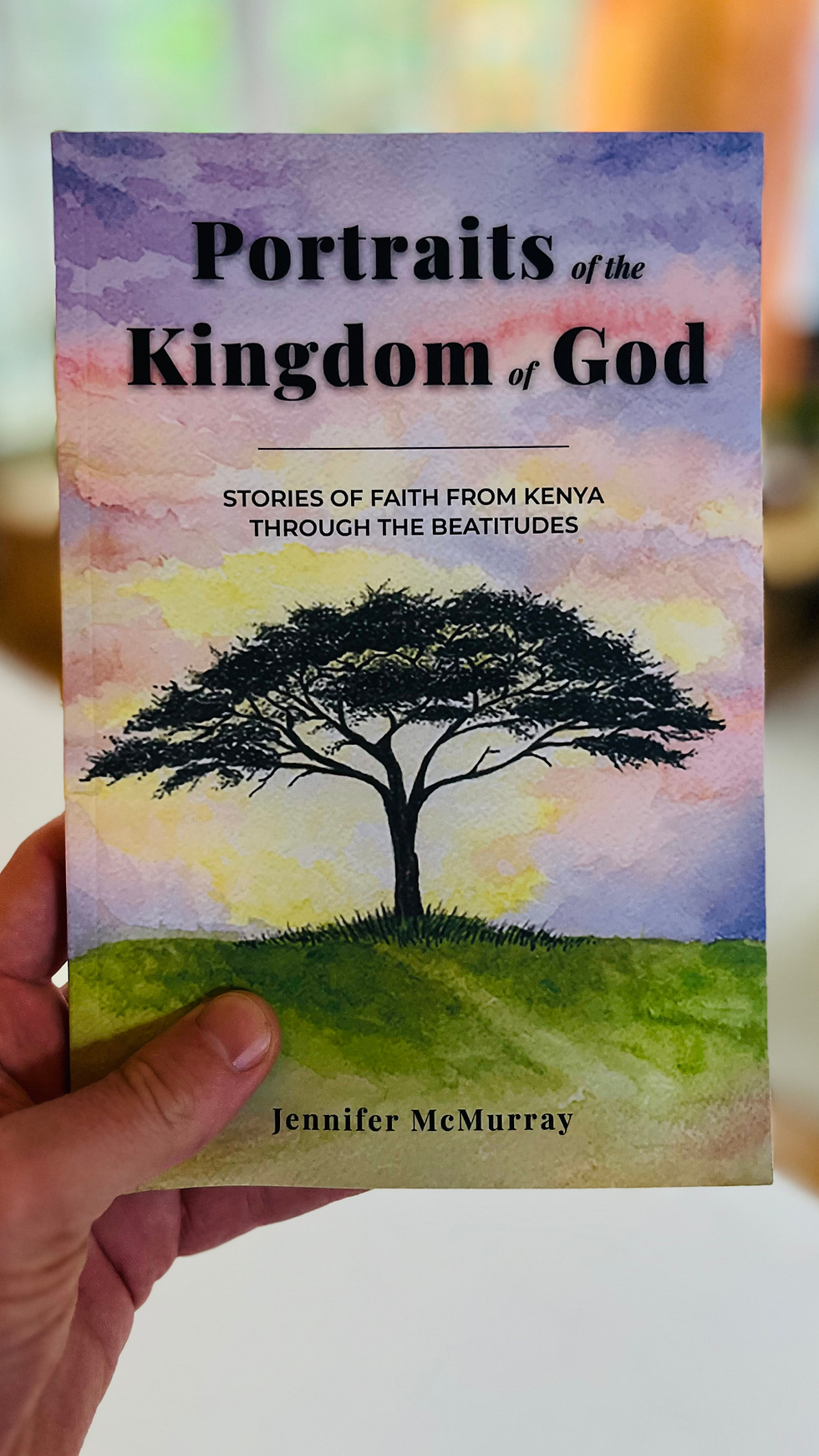
When I sent a picture of the book cover to our Maasai friend John Oldikany, whose story is shared in the book, he replied, “I like the portrait of the acacia tree. So beautiful. Acacia trees mean so much in Maasailand. It provides shade for people and livestock under the hot sun. The leaves and pods are used as fodder for cattle, especially during drought, as it remains green even then. Some parts are used in traditional medicine. It is also used when making very good soup. The thorns create a strong enclosure, called a manyatta, to keep predators away from livestock. The acacia tree is considered a meeting place for elders to discuss community matters.”
From a Christian perspective, John continued, “The acacia tree points to faith during difficult times, endurance and trust in God even in the dry seasons of life. I like that idea of the acacia tree. Praying for the final part of the book. Asante sana.”
“Asante sana” is a Swahili phrase meaning “thank you very much.” I am thanking God for how it all turned out, how He speaks through His Word, and for the friends who helped me along the way. I will never look at an acacia tree the same way again.


Comments